





For many small business owners, entering the federal contracting market can feel complicated. Finding the right opportunities is one challenge, but understanding where a small business fits within the federal procurement system can be just as difficult.
The SBA 8(a) Business Development Program is designed to help eligible small businesses compete for federal contracts and develop their government contracting capabilities. But getting certified is only the beginning. Business owners also need to understand how the program works, what opportunities may become available, and what they need to do to remain compliant.
What Is 8a Certification and How Does the SBA Program Work in Practice?
8a certification is an SBA designation for eligible small businesses that qualify for the federal government’s 8(a) Business Development Program.
But certification is more than simply adding an SBA designation to your company profile. In practice, the program is intended to help eligible businesses compete in the federal marketplace through contracting opportunities, business development assistance, and other resources available to participating companies.
For example, an eligible company providing IT services may identify a federal solicitation that is reserved for 8(a) participants. Instead of competing against every company that can bid on an unrestricted opportunity, the business may compete within the eligible 8(a) pool, depending on the solicitation and applicable federal procurement rules.
There can also be situations where an agency awards an eligible contract directly to an 8(a) participant under applicable sole-source rules and dollar limitations.
This is where the practical value of 8a certification becomes clearer. The certification does not automatically bring contracts to your business. Instead, it can place your company in a position to pursue opportunities that may not be available to every small business.
A business owner still needs to research federal agencies, identify relevant NAICS codes, monitor solicitations, build relationships with contracting personnel, prepare strong proposals, and demonstrate that the company can successfully perform the work.
So, think of the 8(a) Program as a business development and contracting opportunity framework, rather than a guaranteed source of government revenue.

8a Certification Requirements for 2026
Before starting an application, make sure your company appears to qualify under the current SBA requirements.
Generally, an applicant must satisfy requirements related to:
- Small business size under SBA standards
- Ownership and control
- Social disadvantage
- Economic disadvantage
- Good character
- Potential for successful business performance
- U.S. citizenship and other applicable program requirements
The ownership and control requirements deserve particular attention.
The qualifying individual generally needs to own at least 51% of the business and have actual control over the company’s management and business decisions. Simply holding the required ownership percentage does not necessarily establish control.
For 8a certification, SBA may also evaluate the owner’s financial circumstances when determining economic disadvantage. Personal income, assets, and other financial information can therefore become important parts of the application. Because SBA rules can change, applicants should verify the current requirements before submitting their application.
Who Can Qualify for the 8(a) Program?
Eligibility is not based on one factor. A business may satisfy some requirements and still fail to meet others.
For example, a company might qualify as a small business but have an ownership agreement that does not clearly establish the required control. Another business might meet ownership requirements but have financial circumstances that do not satisfy the applicable economic disadvantage criteria.
For 8a certification, business owners should carefully review the following areas.
Ownership
The qualifying individual generally must own at least 51% of the business.
Control
The qualifying owner must generally have the authority to control the company’s operations and important business decisions.
Social Disadvantage
The applicant must meet the applicable SBA requirements concerning social disadvantage.
Economic Disadvantage
The qualifying owner must meet SBA’s economic disadvantage standards. Financial information may be reviewed as part of this determination.
Business Potential
The company must demonstrate that it has the potential to successfully perform and participate in the federal marketplace.
Good Character
Certain conduct, criminal history, or other issues can affect eligibility under SBA rules.
Reviewing these requirements before starting the application can help identify potential problems early.
8a Certification Benefits: What Can Your Business Actually Gain?
The main reason many business owners consider the program is access to federal contracting opportunities.
Below are eight important 8a certification benefits to understand before deciding whether the program is right for your business.
1. Access to 8(a) Set-Aside Contracts
Federal agencies can reserve certain contracts for eligible 8(a) participants. This can give qualified businesses opportunities that are not competed on an unrestricted basis.
2. Potential Sole-Source Contracting Opportunities
Under applicable SBA and federal procurement rules, certain contracts may be awarded to 8(a) businesses without a traditional competitive solicitation.
3. Federal Business Development Support
The program is designed not only around contracting but also around helping participating businesses develop their ability to compete in the federal marketplace.
4. Greater Exposure to Government Buyers
Certification can make an eligible business more visible to federal contracting professionals looking for companies within the 8(a) program.
5. Mentor-Protégé Opportunities
Eligible businesses may be able to participate in SBA’s Mentor-Protégé framework and explore qualifying joint-venture arrangements.
6. Federal Contracting Experience
Winning and successfully performing federal contracts can help a business develop government-specific experience, past performance, and relationships.
7. Networking and Market Development
The program can provide opportunities for business owners to learn more about federal procurement and connect with organizations involved in government contracting.
8. Structured Business Development Period
The program provides a defined development period during which eligible businesses can work toward strengthening their position in the federal marketplace.
These 8a certification benefits can be valuable, but they should not be confused with guaranteed business revenue.
Certification gives an eligible company access to certain opportunities and resources. The company still needs to find the right contracts, submit competitive proposals, maintain compliance, and deliver quality work.
The businesses that get the most from these 8a certification benefits are generally those that treat certification as part of a broader federal contracting strategy.
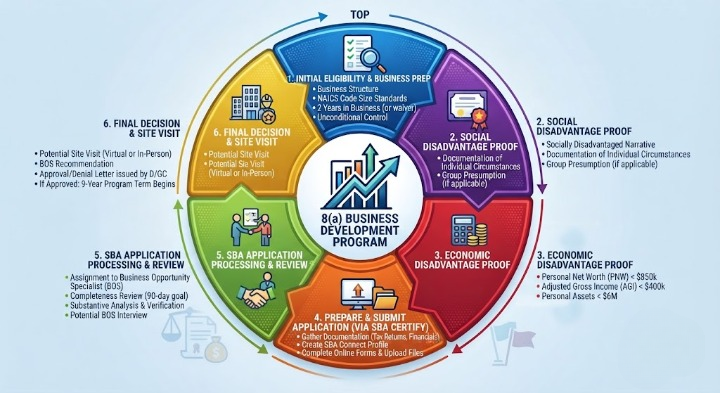
How the 8a Certification Application Process Works
Once you believe your company meets the requirements, the next step is preparing the application.
The 8a certification application is completed through the SBA’s online process. Before starting, gather your business, ownership, tax, and financial records.
A practical approach is to work through the process step by step.
Step 1: Check Your Eligibility
Review the ownership, control, size, citizenship, social disadvantage, economic disadvantage, and other applicable requirements.
Step 2: Collect Your Documents
Gather corporate formation documents, ownership records, tax returns, financial information, identification, and other documents relevant to your application.
Step 3: Review Your Business Structure
Look carefully at your operating agreement, bylaws, stock records, partnership documents, or other governing documents.
Your paperwork should clearly support the information you provide in the application.
Step 4: Complete the Online Application
Provide accurate information throughout the 8a certification application.
Do not estimate or guess when you have access to the correct financial or business records.
Step 5: Respond to SBA Questions
SBA may request additional documents or clarification during its review.
Respond carefully and within the requested timeframe.
Step 6: Receive the Decision
After reviewing the application and supporting information, SBA will make a determination based on the applicable requirements.
The 8a certification application should not be treated like a simple form that can be completed quickly without preparation. Inconsistencies between your application, tax returns, ownership documents, and financial records can create unnecessary questions.
What Documents Are Usually Needed?
The exact documents can vary depending on the company and its ownership structure.
Applicants should generally be prepared to provide information related to:
- Articles of incorporation or organization
- Operating agreements or bylaws
- Ownership records
- Stock certificates, where applicable
- Federal tax returns
- Personal financial information
- Business financial information
- Identification and citizenship
- Business licenses, where applicable
- Management and control information
Before submitting an 8a certification application, compare the information across your documents.
For example, if your operating agreement says one person owns 60% of the company but another document indicates a different ownership percentage, SBA may need additional clarification.
That type of inconsistency is avoidable with a proper document review.
How Much Does 8a Certification Cost?
A common question is whether a business has to pay the SBA a certification fee.
The SBA application process is not simply a commercial certification where a company pays a fee in exchange for approval. However, applicants can still have expenses while preparing their application.
Possible costs may include:
- Attorney fees
- Consultant fees
- Accounting services
- Financial statement preparation
- Legal document updates
- Internal administrative time
A business does not necessarily need to hire a consultant or attorney.
If your ownership structure is straightforward and your records are organized, you may be able to prepare the application yourself.
The important thing is to understand the difference between SBA requirements and optional professional assistance.
Common Problems That Can Delay an 8a Application
Many application problems come from incomplete preparation rather than complicated SBA requirements.
Ownership Information Does Not Match
Your ownership percentages should be consistent across your corporate documents, tax records, and application.
The Qualifying Owner Does Not Clearly Control the Company
A person may own the required percentage but still have limitations on actual control. SBA can examine how the business is managed in practice.
Financial Information Is Incomplete
Missing or inconsistent financial information can lead to additional questions.
The Applicant Misunderstands Social or Economic Disadvantage
Applicants should carefully review the current SBA standards instead of assuming that personal circumstances automatically satisfy the program requirements.
Documents Are Submitted Without Review
A rushed application can contain simple errors that could have been caught before submission.
These issues are especially important when preparing an 8a certification application because inconsistent information can lead to additional review and delays.
How Long Does 8a Certification Take?
There is no single guaranteed processing time for every applicant.
The timeline can depend on factors such as the completeness of the application, the complexity of the business structure, whether additional information is requested, and SBA’s workload.
Instead of focusing only on how many days the process might take, focus on submitting a complete and internally consistent application.
A properly prepared 8a certification application can reduce avoidable back-and-forth during the review process.
Is 8a Certification Worth It in 2026?
For an eligible small business that genuinely wants to build a federal contracting business, the program can be worth considering.
The strongest 8a certification benefits are connected to access to certain federal contracting opportunities and business development resources.
However, certification should never be viewed as a shortcut to government revenue.
Before applying, ask yourself:
- Does my company meet the current eligibility requirements?
- Are my ownership and control documents clear?
- Does my business have services that federal agencies purchase?
- Do I understand my relevant NAICS codes?
- Can my company perform government contracts?
- Do I have relevant experience or past performance?
- Do I have a plan for finding federal opportunities?
If the answer is yes, 8a certification may be a useful part of your federal contracting strategy.
Frequently Asked Questions
Does 8a certification guarantee government contracts?
No. 8a certification can provide access to certain contracting opportunities, but it does not guarantee that your business will win a contract.
You still need to identify relevant opportunities, meet solicitation requirements, submit competitive proposals, and successfully perform the work.
Is there an SBA fee to apply for the program?
The SBA certification process is not simply a paid certification program. However, businesses may incur optional costs for attorneys, consultants, accountants, or other professional services.
Can a new business apply?
Potentially. A new business may qualify if it satisfies the applicable SBA requirements, including requirements related to business potential and eligibility.
However, new businesses should carefully evaluate their circumstances before beginning an application.
Can I complete the application myself?
Yes. A business can prepare its own 8a certification application.
Professional assistance may be useful when the business has complicated ownership arrangements, multiple owners, unusual financial circumstances, or document inconsistencies.
What is one of the most common application mistakes?
One major problem is inconsistency between the information submitted to SBA and the company’s existing legal, tax, ownership, or financial records.
Reviewing the complete application before submission can help prevent this.
What happens after SBA approves the business?
Approval is not the end of the process.
A certified business should actively look for appropriate federal opportunities, maintain its eligibility and compliance obligations, develop relationships with agencies, and make practical use of the resources available through the program.
Final Thoughts
The SBA 8(a) Program can provide meaningful opportunities for eligible small businesses that want to build a presence in federal contracting.
But the value of the program starts with proper preparation.
Before submitting an 8a certification application, review your eligibility, organize your documents, check your ownership and control structure, and make sure your financial information is accurate and consistent.
The real 8a certification benefits come from using the certification strategically. A business that actively researches federal opportunities, builds agency relationships, prepares competitive proposals, and delivers strong results is in a much better position to benefit from the program.
If you are considering 8a certification in 2026, do not look at it simply as another business credential. Look at how the program could fit into your overall federal contracting plan.
A well-prepared application can help you start that process with fewer avoidable problems and a clearer understanding of what comes next.
