




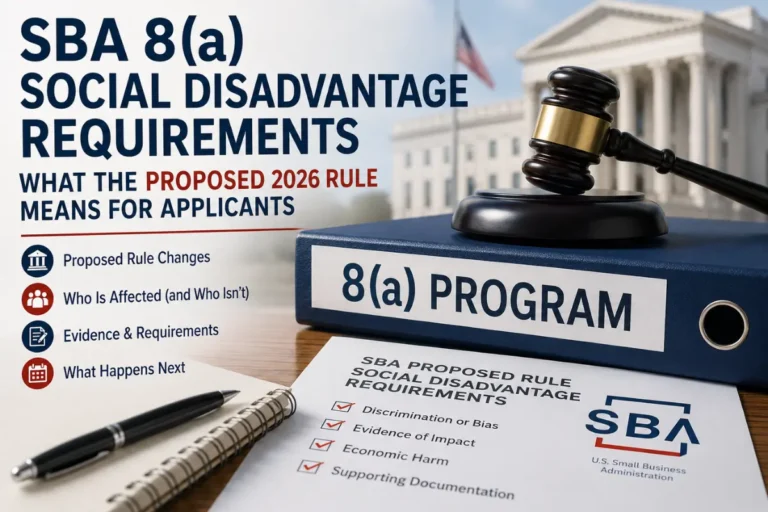
In a move to clarify how Social Disadvantage is viewed by our current administration, the SBA’s proposed rule entitled “Reforms to Remove SBA’s 8(a) Program’s Rebuttable Presumption of Social Disadvantage for Individually Owned Firms Only; Reforms Do Not Impact Entity-Owned Firms,” landed earlier this month (June 11, 2026). And while some of it is certainly continuing their trend, it is not all encompassing. This proposed rule does not impact current individually-owned participants in the U.S. Small Business Administration’s (SBA) 8(a) BD Program, or entity-owned firms in said program.
Since the beginning of this year, January specifically, approval for 8(a) applications have slowed down significantly. While firms have waited on further guidance from the SBA that was said to be incoming as to how to handle the presumption of social disadvantage, this has created an uncertainty that will hopefully be eased by this latest move. Of course it is just proposed, the hope is that with more reflection from the federal government, there will be more direction.
Proposed SBA 8(a) Social Disadvantage Requirements Under the New Rule
Social Disadvantage requirements for the 8(a) BD Program as administered by the SBA could look like this, according to this new proposed rule:
- U.S. citizen (any citizen) show;
- during his or her lifetime;
- a governmental or private entity in the United States (such as a federal, state or local government, university or corporation);
- through an action, policy, rule, regulation of any of its agencies, subsidiaries or authorized agents;
- discriminated or was biased against a racial, ethnic, or cultural group of which the U.S. citizen is a member of or favored a racial, ethnic, or cultural group of which the U.S. citizen is not a member of;
- the U.S. citizen must establish that such discrimination or bias resulted in loss of access to capital or diminished economic advancement.
In short, providing the details of the negative financial impact that this had on you will be par for the course. This will of course include the very basic assertion that of your own self-certification, and that you were a member of a particular group discriminated against at the time of what made you socially disadvantaged. You can’t just say that you were discriminated against, or not a member of a group that was given preference
Evidence Requirements for Discrimination or Bias
In fact, the SBA is proposing that a core requirement for approval would also include “evidence” of the government’s, university’s, or corporation’s action, policy, rule, or regulation that discriminated against the U.S. citizen’s group be given in detail. Examples of this could be what is now deemed as “unlawful” DEI programs or policies, race-based quotas, set-asides, hiring targets, “unlawful” affirmative action programs or policies, or anything that has given an advantage to any group over others (ie, yours) on the basis of race or whatnot, when it comes to the aforementioned.
Who Qualifies: Other 8(a) BD Program Requirements
Any U.S. citizen that can show much of this, in addition to the other longstanding requirements of the 8(a) BD Program that include economic disadvantage, good character, potential for success including two years in business, etc., etc., will be in a great position to have their application approved and become 8(a) certified.
Current 8(a) Participants and Entity-Owned Firms Find Exception
Not everyone will be affected by the proposed rule, namely that it “does not affect participants currently admitted to the 8(a) BD Program,” and that “SBA does not currently intend to apply the new test to current Participants at their next annual review,” as well as companies that are owned and controlled by entity-owned firms, such as tribes, Alaska Native Corporations, Native Hawaiian Organizations, or Community Development Corporations. The SBA is requesting feedback on the former. For further explanation concerning that and/or to give the aforementioned feedback promoting dialogue, click here.
Of course all of this comes roughly three years since the decision in Ultima Servs. Corp. v. U.S. Dep’t of Agric., 683 F. Supp. 3d 745 (E.D. Tenn. 2023), which directed the SBA from applying the rebuttable presumption of social disadvantage in administering the 8(a) BD Program. Since Ultima, SBA has not applied a rebuttable presumption of social disadvantage but has required all participants and applicants to demonstrate the social disadvantage that the qualifying owner(s) of the firms has endured due to an objective distinguishing feature (i.e., race, ethnic origin, gender, physical handicap) that has negatively impacted the individual’s entry into or advancement in the business world. The aforementioned proposed rule explains, this practice still “persisted until 2025 when certain related practices and policies were terminated.”
From here, where do we go?
This is just a proposal, and as I previously mentioned, comments have been solicited until July 13, 2026. If you are considering submitting an 8(a) application, or waiting for a decision on a submission, the proposed rule changing the requirements for social disadvantage it is highly likely that this will have an impact on you. And since we are the foremost experts on the SBA’s 8(a) BD Program, I recommend contacting the industry expert, ez8a. We do not charge for an initial consultation. And once you have that information I believe you will see that their assistance is a must regarding your future operating in the government marketplace.
