




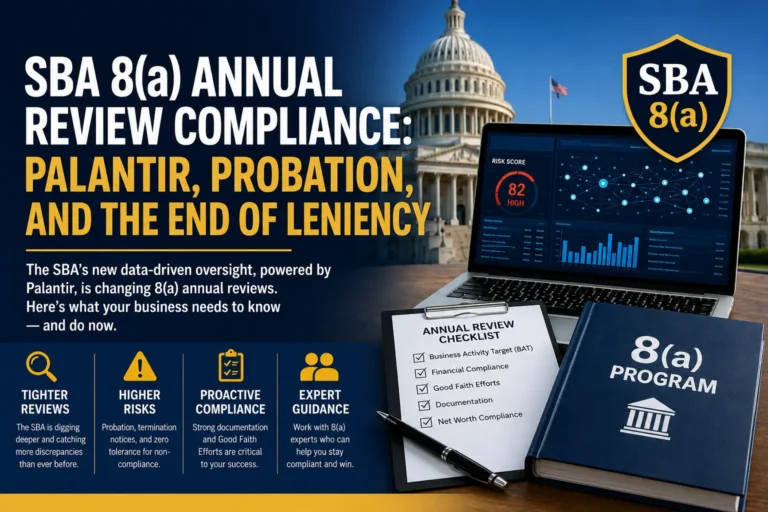
As a current member of the 8(a) BD Program, you have come to know the “working” rules of the annual review process. I have been assisting firms with their renewals for over two decades, the veracity of this process for you has been tied directly to your revenue.
How 8(a) Annual Reviews Worked in the Past
Typically, if your firm was making under $5 Million, your review was often a quick inventory of what you’ve been doing, with little accountability. From $7 Million to $12 Million, it was ratcheted up a bit. But when you the $12 Million threshold roughly, there was an expectation that you would expect the SBA to deep dive into what you were doing.
Even then the SBA’s process was not unforgiving. It was extremely commonplace for firms with one or more compliance issues to get their annual renewal approved nonetheless. If an issue arose with the SBA, such as missing your Business Activity Target (BAT) or inching close to your adjusted net worth limits, the standard operating procedure was cooperation.
There would be a remediation plan put into place, or be placed on probation for a short period of time, thus demonstrating you were an active participant in fixing whatever issues you needed to remedy.
Major Changes in 8(a) Annual Reviews in 2026
The new reality of the 8(a) annual review has changed substantially in the last six months. And the reasons? The SBA has shifted towards the use of Palantir, a massive data analytics and software firm, to stiffen oversight. While Palantir’s $300,000 first contracted it was presented as a “Fraud Prevention Pilot” linked to a sweeping probe into pandemic-era loans, the operative effects are touching the 8(a) Business Development Program, and it is not gentle.
Also Read: 8a Certification Denied? Here’s How to Reapply and Win
These Are the Two Major Shifts I Am Seeing Resonate Currently
The new reality of the 8(a) annual reviews has changed substantially in the last six months. The SBA has shifted towards the use of Palantir, a massive data analytics and software firm, to stiffen oversight.
1. The End of the “Easy Review.”
The SBA is leaving very few stones unturned when it comes to more critical reviews. While it is hard to confirm that they are auditing every single firm in depth, they are definitely catching discrepancies that previously had sailed through unnoticed in the past.
The SBA reported in early 2026 that it had suspended over 1,000 8(a) firms for failing to provide requested documentation, so the changes are being felt already in real time. This new data-driven approach is leaving far less room for error in this new era of administrative oversight.
2. From Cooperative to Adversarial Oversight
The harshest change is the shift in the SBA’s seeming stance. They no longer conduct themselves as a cooperative development partner, the oversight feels downright adversarial. They are now looking for reasons to remove firms from the program.
The BAT Shift in 8(a) Annual Reviews:
In the past, if you missed your non-8(a) revenue targets, you could submit a Good Faith Efforts waiver, explaining your efforts to win open-market work, thus avoiding probation. Missing that target now usually results in instantaneous probation.
Net Worth Triggers and Termination Notices:
The margins when it comes to everything have become more precarious, if a business owner is even suspected to be over the adjusted net worth limits, we are seeing the SBA issue immediate 30 day notices of termination, rather than opening up a dialogue for communication that will help explain the financials first.
So, How to Stay Compliant and How Do You Operate Now?
The time when one could rely on administrative leniency or “administrative errors” to save you has come and gone. For example, I recently had a client who won a competitive task order under the 100% 8(a) STARS III GWAC. The Ordering Contracting Officer accidentally checked the “Small Business” box on the SF1449 award document instead of the 8(a) box. The client wanted to be clever and use that administrative error to classify the revenue as non-8(a) to meet their Business Activity Target.
My advice to them, and to you: Do not fight the SBA on these interpretative details. Because STARS III is a 100% 8(a) vehicle, the SBA will view every dollar through it as 8(a) revenue, whether an errant checkbox on an order form is checked or not. Fighting this today is counterproductive AND an uphill battle that will only invite further scrutiny from your Business Opportunity Specialist.
It is best to proactively manage your compliance. If you are going to miss your BAT, you need to rely on the “Good Faith Efforts” waiver outlined in 13 CFR § 124.509(d)(1)(i)(A). You must painstakingly compile the non-8(a) bids you submitted in the last year to officially prove you were actively competing in the open market. In this new data-driven, oppositional environment, stringent documentation is how you have to operate.
Final Takeaway:
To properly navigating changes like these in how the federal marketplace and/or the SBA conducts business, contacting an industry expert such as ez8a is the go to move. They never charge for an initial consultation.
