




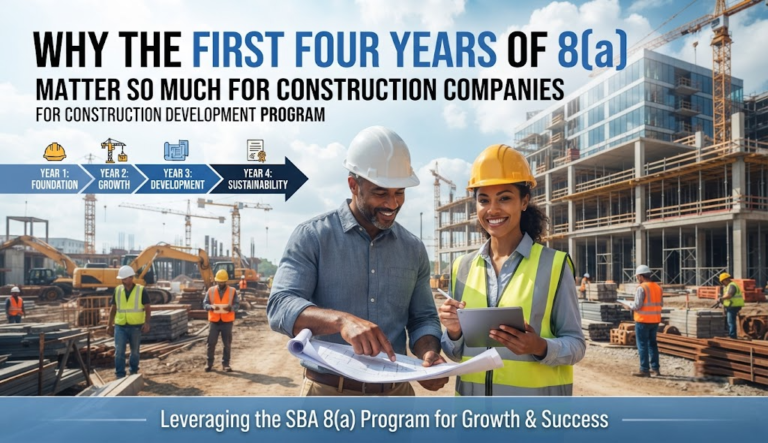
8(a) construction firms can do very well selling to the federal government, many having sales over $10MM per year. However, most get off to a slow start which affects current and built upon future sales. Therefore, we are going to go over how fast a firm can get out of the starting blocks faster!
The 8(a) Construction Sales Ramp – The Problem
Looking at the construction cohort we’ve analyzed, average annual federal sales per 8(a) firm starting in most cases with zero sales rise substantially during the first four years:
| Year in 8(a) | Average Annual Federal Sales per Firm | Growth vs. Year 1 |
| Year 1 | $550,000 | – |
| Year 2 | $880,000 | +60% |
| Year 3 | $1.38 million | +151% |
| Year 4 | $3,28 million | +496% |
*Data Source USA Spending 2025, DSBS
What Separates the Fast Winners?
The early evidence suggests that successful construction firms don’t necessarily begin by selling to dozens of agencies. They establish themselves with a specific federal buyer.
For construction, that can mean a military installation, NAVFAC office, Army/USACE organization, GSA Public Buildings Service office, or another organization that continually maintains and renovates federal facilities.
The first opportunity can be small, just get your foot in the door early.
A contractor might start with a relatively modest:
- building renovation; roof or HVAC project; interior alteration; facility repair; security improvement; paving/site project; utility upgrade; or design-build renovation.
The Fast-Winner Strategy
A new 8(a) construction contractor should therefore think less about “selling to the federal government” and more about becoming a contractor for several specific federal facilities.
A practical first-four-year strategy looks something like this:
| 8(a) Year | Primary Objective | What the Contractor Should Be Doing |
| 1 | Get the first federal customer | Target 3–5 installations/facilities, meet contracting offices, market 8(a) capabilities, pursue manageable repair/renovation work |
| 2 | Turn one customer into repeat business | Re-market successful projects, pursue follow-on requirements, learn the buyer’s acquisition patterns, identify local IDIQs |
| 3 | Get onto recurring vehicles | Pursue construction IDIQ/MATOC/MACC opportunities, expand to nearby installations and related contracting offices |
| 4 | Scale the relationships | Compete for larger 8(a) projects, increase bonding capacity, add task-order vehicles and expand from one successful buyer to several |
Find the Buyer, Not Just the Opportunity
Imagine an 8(a) construction company located near a large military installation.
There may be hundreds of federal construction opportunities nationwide. But a $300,000 renovation project at the installation 30 miles away could be strategically more valuable than a $2 million opportunity 1,000 miles away.
Why?
Because after successfully completing that first local project, the company now has:
- Federal past performance.
- A contracting officer who knows the company.
- A facility/customer that has seen its work.
- Local subcontractors already assembled.
- Knowledge of the installation’s procedures.
- A project it can show to other federal buyers.
That creates a completely different competitive position for the next opportunity.
And there is another important structural advantage: once a requirement has been accepted into the 8(a) program, federal guidance generally requires it to remain in the program unless SBA agrees to release it.
That can make established 8(a) buying relationships particularly valuable.
Year 3+ The Endgame Is the IDIQ
The first sole-source or small competitive project gets you through the door. But that isn’t necessarily where the largest long-term value lies. The next objective should be getting onto the IDIQ, MATOC, MACC or other construction vehicle that the installation or contracting organization uses repeatedly. Now the contractor isn’t starting from zero every time the government needs another roof, renovation, facility upgrade or repair. It is already one of the contractors eligible to compete for task orders. That’s when the relationship can begin producing recurring revenue.
Don’t Waste the Development Stage
There is another reason the first four years deserve so much attention. SBA describes the nine-year 8(a) program as having a four-year developmental stage followed by a five-year transitional stage. Our construction sales data makes that distinction particularly interesting. The first four years in our dataset look like this:
$550K → $880K → $1.38M → $3.28M
That doesn’t prove that simply spending four years in 8(a) causes revenue to increase.
A much more useful interpretation is that successful contractors appear to be accumulating something during those years:
past performance + buyer relationships + bonding capacity + contract vehicles + repeat work. By Year 4, those assets can begin working together.
What Should a New 8(a) Construction Firm Do Tomorrow?
Don’t start with a list of every construction solicitation in the United States. Start with a map.
Identify the three to five federal installations or major federal facilities where you can realistically perform construction work.
